
Giving communities the information, time and space to develop their own local energy vision

Renewable energy
The community energy projects that FEL supports are those that involve renewables. Many people across the UK are seeking ways to reduce climate change and reduce the country’s dependence on imported energy, and the switch to renewable energy is the most effective way to do this.
More of the energy we produce in the UK is coming from renewable sources - wind, solar and hydro. It was over 52% in 2025. We now generate much less from traditional sources like gas and coal.
The most common forms of renewable energy for community energy groups are solar and wind.
Wind turbines
-
Wind turbines turn energy from the wind into electricity. When the wind blows across the blades it causes them to spin and this motion is transferred into electricity which travels through cables to the national grid.
-
Wind turbines work best in open places where no obstacles block the wind.
-
In 2025, more of our electricity was produced by wind power than any other source, including gas.
-
Most wind turbines are between 100 and 160 meters tall. This is at least twice as tall as the average electricity pylon.
-
A 100m wind turbine can generate enough power about 500 homes, while a 160m turbine can generate enough power for over 2,000 average homes.
-
Examples of wind turbines or wind farms owned by community groups include Awel Co-op, Energy Local Bridport and Ambition Community Energy.

Solar farms
-
A solar farm is a group of ground-mounted solar panels that convert energy from the sun into electricity. The panels use a material (usually silicon) to convert energy from the sun into electricity.
-
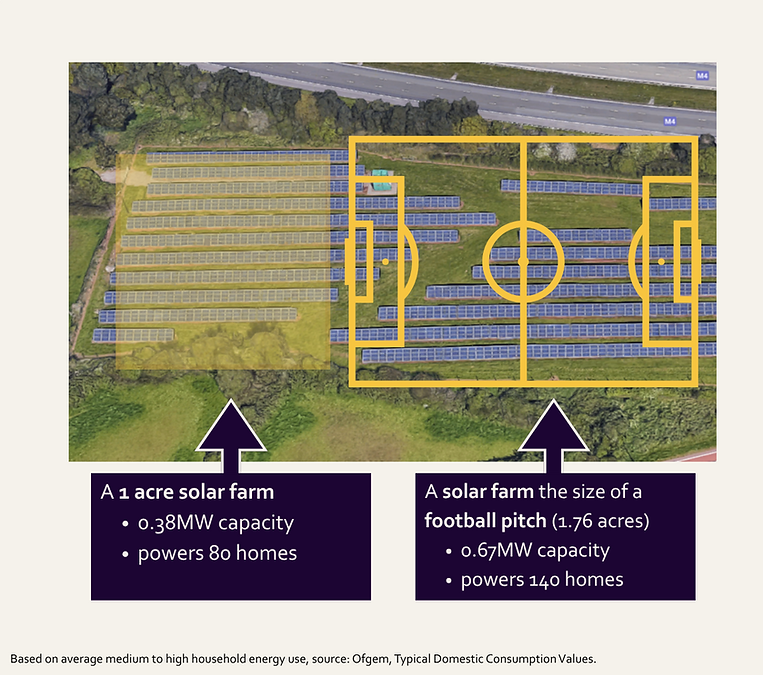
A solar farm covering an acre – that’s about two-thirds of a football pitch - can generate enough power for about 80 homes.
-
Many solar farms, including large ones, are owned by community groups. Examples include Acomb Community Energy, Forest Gate, and Westmill. The largest community-owned solar farm in the UK is Ray Valley Solar in Oxfordshire, with a capacity of 19.2 megawatts. However, most community-owned solar projects are considerably smaller, typically five megawatts or below.
-
One of the key advantages of the community energy model is its ability to make smaller-scale projects financially viable. Projects that would often be too small to attract investment from commercial developers who work on a larger scale.
-
Although rooftop solar has an important role to play in the future, on average it only provides about 40% of a home's electricity needs. And the demand for electricity will rise as households switch from gas heating and combustion cars to heat pumps and electric vehicles. This is why Future Energy Landscapes includes solar farms as well as rooftop solar.
Renewable energy questions
Neil Best, Senior Planner at Centre for Sustainable Energy has run dozens of Future Energy Landscapes workshops across the south of England. He says: “Lots of people at our events have questions about renewable energy. Because we have limited time, we can’t always answer every question. Below is a list of questions that we get asked the most, and our replies."
We’ll be adding to this list as more questions come up.